

Farming
I.
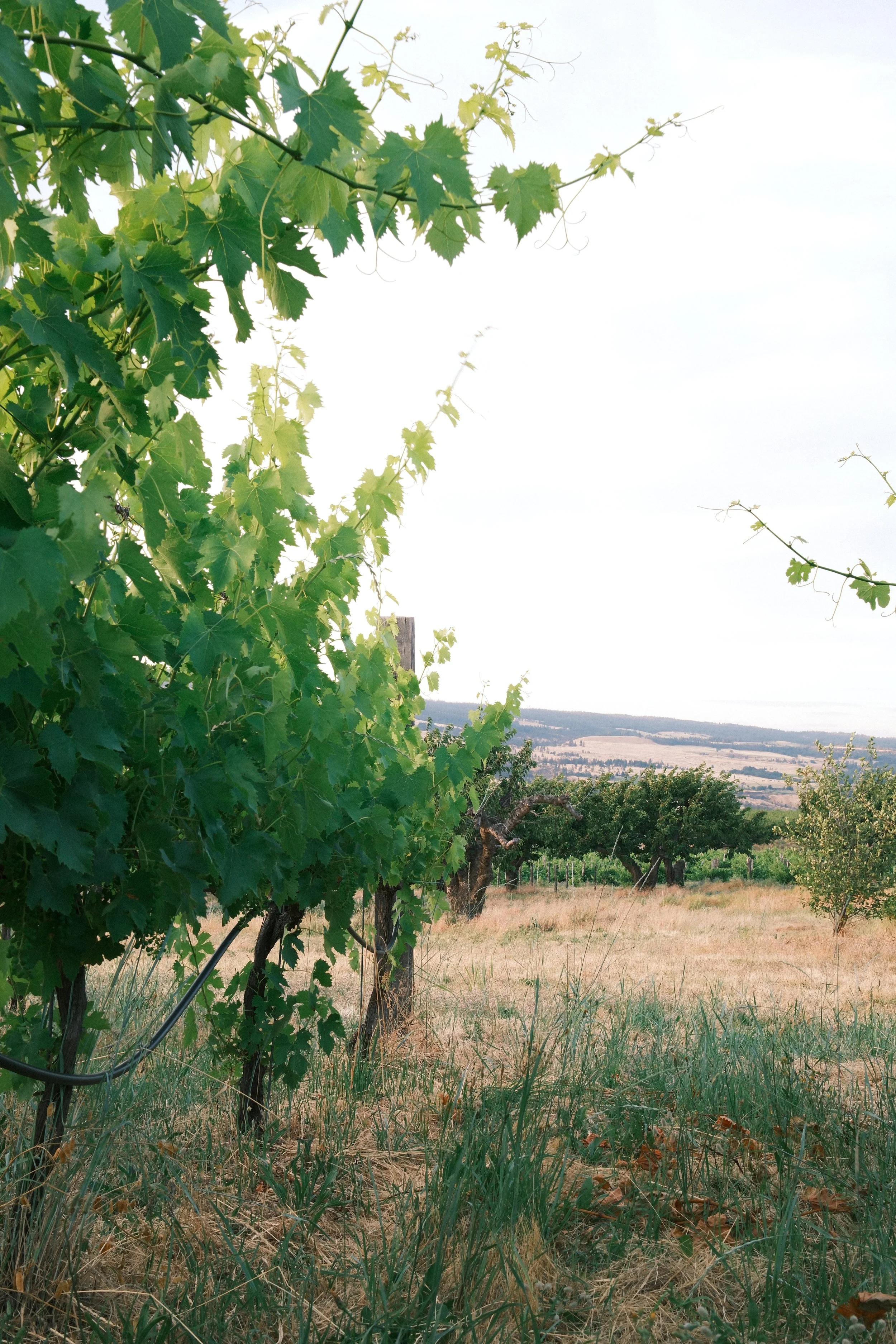
Our work in the field is guided by decisions we make in the kitchen. We want the food on our own table to be simple, perfect, and rustic, and this farm is in some sense an elaborate way of acquiring the best possible ingredients for that purpose. We farm for taste, often at the expense of efficiency. In the tradition of our region, we farm orchard crops including cherries, pears, apples, and quince, but it is wine grapes, and winemaking, that sustains Idiot’s Grace.
Wine is a kind of food made over a long time. Years elapse between planting a grape vine and tasting the first wine made from its fruits. It takes years more to learn the character of the vine as it expresses itself here. Only with patient effort can we learn what grapes will be right for this place, and only with wild fermentation can we make a wine that is truly at home here.
We have been farming these fifty acres since 2002, but our project is still an experiment. The Columbia Gorge is a wine region in its infancy, and the lasting character of the wine tradition here has probably not yet been discovered. Three generations of our family work at Idiot’s Grace, and we work in the hope that the project will outlast us. It is with an eye on the long view that we have planted twenty-four varieties of wine grapes here, and that we restlessly adjust our practices in both the field and the cellar. There is no shorter path; this is what it takes to help raise the young tradition.
II.
Much is made of the cellar, but the heart of a wine is formed in the field. Our farming is organic and undogmatic. We are low-input as a matter of both ethics and economy. We try to be scientific in our management, but we take on faith the idea that anyone seeking to make expressive, original wines will need grapes grown in a complex and active community of living things. We do our best to steer the agrarian ecosystem for biodiversity and beauty. The farm is certified organic.
III.
We farm wine grapes, cherries, and pears on a commercial scale, but we are habitual planters, and today we grow a few hundred heirloom varieties of fruiting trees and vines. We have planted diversely as a first step toward discovering what wants to be here: which plants are healthiest, and which yield the best tasting, most beautiful fruit here in Mosier.
When the harvest inspires a good idea, the fruit makes it to the tasting room kitchen, and from there, often, to our menu.
Our oldest cherry trees are more than one hundred years old, and though their wide spacing and low production makes farming them an anti-economical choice, they still produce delicious cherries, so they stay. Among and between the established blocks we interplant hedges and gardens of herbs, shrubs, and trees.
IV.
There is a huge catalog of words now in use to describe different kinds of farming, but in general the words are neither precise nor vital enough for what they describe. The texture of earth underfoot, the sounds of what lives in the orchard, and certain seasonal smells are better, I think, than the explanations and certifications. We invite you to visit Idiot’s Grace, walk around, and get a sense for the place.